About the Friends of the Horticulture Farm
News/Calendar
Newsletter
Collections
Membership
Internships
ContactUs/Directions/Map
Site map
Join the Friends
Woodland Walk
Birdhouse Brochure
 
The Friends of the Horticulture Farm is a grassroots organization dedicated to protecting, enhancing and promoting the significant plant collections and natural areas of the UVM Horticultural Research Center in
South Burlington, Vermont for education, research,
and public enrichment.
 
Woodland Walk flowers
Feature Article


Avoid Lyme Disease While Gardening
by Dr. Leonard Perry, Extension Professor, University of Vermont

Lyme disease is a potentially disabling disease of
joints and the nervous system, spread by deer ticks.
It is important to know about this disease, how it is
spread, and the steps to;avoid it, as gardeners may come
into contact with these ticks.

This previously unknown disease was first found in
children in Lyme, Connecticut, in 1975. It was given
its current name, ticks were identified as the vector
spreading it, and in the early 1980's research identified
the cause as a spirochete bacterium. It has since
become the most reported vector-bome disease in the
country. It is prevalent in the Northeast, parts of the
Midwest, and parts of the Northwest. While southern
New England areas are at high risk, much of the rest of
New England is at moderate risk with only the most
northern parts at low risk.

Although this disease is rarely fatal, it can cause
debilitating illness including heart irregularities, facial
paralysis, and impairment of the nervous system. Early
symptoms to watch for include minor symptoms such
as skin rash, fever, headaches, and muscle and joint
pain. Very characteristic is a skin rash called
"erythema migrans". This rash appears as a red circular
patch at the site of a tick bite within three days to one
month. As it enlarges, this patch often takes on a
"doughnut" or "bulls eye" appearance. As ticks like
warm spots, parts of the body to watch are thighs, groin,
trunk, and armpits.

Of course many tick bites will cause an allergic
reaction, but shouldn't be confused with the symptoms
of Lyme disease. Such non-serious allergic reactions
appear within a few hours or days, do not expand or
have the bulls-eye feature, and disappear in a few days.

Although there are no vaccines to prevent Lyme
disease, it can be treated with antibiotics once
diagnosed. Prompt treatment, however, is important.
Early treatment usually results in full and rapid
recovery. Permanent damage may occur if treatment is
in the very late stages.

Although three types of ticks can carry the disease, the
deer ticks get the most mention. Ticks feed on small
rodents, birds, and deer that may carry the Lyme
disease but not be affected by it themselves. This is
where the ticks pick up the bacteria, and then transmit
it to humans. If a tick bites a human and remains
attached for 24 to 48 hours, the bacteria may spread into
the bloodstream and begin to cause the above
symptoms.

Avoiding places where ticks live or checking for tick
bites if you are in such areas is a primary means of
prevention of Lyme disease. Ticks like cool, wet places
such as wooded areas, piles of debris, and high grasses.
If you garden in or around such areas, watch for ticks
and tick bites. Any other activities in such areas are
also at risk, such as camping, hiking, fishing, hunting,
or walking pets.


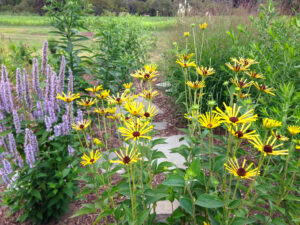
Photo taken in the Woodland Walk, June 2007, by Jen Mills

FOR MORE ARTICLES AND TO SEE THE CURRENT NEWSLETTER CLICK HERE.


News
 

May 10, Saturday
11 – 1 p.m.
Trillium Walk & Plant Propagation

Presenter: Stephanie Solt.
Register by May 5.

May 15, Thursday
5:30 – 8 p.m.
Lilac Pruning Workday


May 17, Saturday
10 a.m. – 3 p.m.
Bloom-Time Festival


More News and Events >


PLEASE ALSO VISIT THE WEB SITES OF SOME OF OUR LOCAL GARDENING FRIENDS/SUPPORTERS:


    Branch Out Burlington  


Photo gallery
Home | About the Friends of the Horticulture Farm | News/Calendar | Newsletter | Collections | Membership | Internships
Contact Us/Directions/Map | Site Map | ©2008 The Friends of the Horticulture Farm

SITE DESIGNED AND BUILT BY SARAH MONTGOMERY DESIGN